


Buyer's Guide: Integrated Office Parking System vs Workplace Parking Software

Mobility hubs are moving from “future vision” to critical city infrastructure. They’re expected to reduce congestion and emissions, make cities more livable, and still keep everyday mobility practical for people and goods.
Yet many mobility hub initiatives underdeliver for one simple reason: we confuse infrastructure with adoption.
You can build a hub, add EV charging, install bike parking, invite shared mobility partners, and publish a mobility strategy—and still see limited behavior change. Not because people consciously “choose green,” but because friction wins. When the hub alternative feels uncertain, fragmented, or complicated, users default back to what’s familiar.
Mobility Hubs 3.0 start from a different premise
The user experience is the “moment of truth” where policy becomes real.
If the journey is predictable and seamless, behavior changes naturally—at scale.
This is not a “UX project.” It’s a coordination project across many stakeholders—and the experience is the visible result.
The city challenge: hubs are built in layers
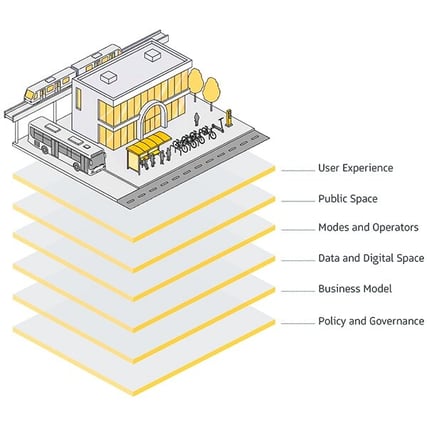 A mobility hub is not a single system. It’s a layered city product that must hold together across:
• Policy & Governance (rules, access, incentives, compliance)
• Business Model (investment, operating model, revenue logic)
• Data & Digital Space (integration, identity/entitlements, transactions, insights)
• Modes & Operators (public transport, parking, charging, micromobility, logistics)
• Public Space (design, safety, wayfinding, accessibility)
• User Experience (the only layer people actually “feel”)
The implication is crucial: adoption is never created by one layer alone. It happens when these layers align so the journey feels effortless.
Why mode shift stalls: the intention–action gap
Most users are not making a sustainability decision. They are pro-certainty—and they respond to constraints like congestion, limited parking, and access restrictions.
Their real questions are practical:
• Will there be space when I arrive?
• How do I pay—without surprises?
• Do I need another app?
• What happens if charging is occupied?
• Is the transfer safe and easy to find?
• Will I get fined if I misunderstand a rule?
When answers are unclear, the decision is made for them—by friction.
For city authorities, this shows up as persistent inner-city traffic, underused Park & Ride capacity, and a gap between policy ambition and measurable outcomes.
For parking operators, it shows up as avoidable bottlenecks, higher support load and disputes, inconsistent occupancy patterns, and a customer journey that breaks at the most sensitive moments (entry, payment, exit).
Mobility hubs aren’t places. They’re journeys.
If you want adoption, stop thinking in “hub features” and start thinking in journey stages. The experience begins long before arrival and ends long after departure.
Stage 1: Pre-arrival (confidence is built here)
• Discoverability and clarity: what the hub offers, where to go
• Pricing transparency: predictable rules, no surprises
• Availability and certainty: real-time information where possible
• Reservations where appropriate (commuters, events, constrained hubs)
• Clear policies: time windows, entitlements, LEZ-related rules
Mobility truth: Many decisions happen before people leave home. If confidence is missing here, the hub won’t become a habit.
Stage 2: Arrival (anxiety is highest here)
• Guidance and wayfinding that reduces “search traffic”
• Frictionless entry (ticketless/touchless)
• Confirmation cues that “the system is working”
Mobility truth: Confusion at arrival creates distrust—and destroys repeat usage.
Stage 3: On-site (the promise is tested here)
• Simple, safe, intuitive transfers between modes
• Charging access and payment that feels reliable
• Easy access to bike storage, shared mobility, parcel lockers, etc.
• A self-service experience that doesn’t require asking for help
Mobility truth: The hub must feel effortless—even when it’s busy.
Stage 4: Post-visit (trust is created or destroyed here)
• Automatic payment completion
• Receipts and auditability
• Dispute-free processes
• Incentives/loyalty where relevant
Mobility truth: Payment friction is one of the fastest ways to turn a good hub into a one-time experiment.
The levers that actually change behavior (without feeling manipulative)
Mobility Hubs 3.0 influence behavior through four practical levers that matter to both cities and operators.
1) Remove friction
Ticketless access, automated payment, and consistent rules reduce cognitive load. If the hub feels like “one more thing to manage,” it won’t become default.
2) Increase certainty
Availability signals and guidance reduce circling and bottlenecks. Certainty is not a “nice UX feature”—it’s a congestion strategy. Transparency is the hygiene factor: real-time data upfront and during the journey—and the option to reserve where appropriate—gives peace of mind.
3) Use incentives fairly
Flexible pricing and incentives can spread demand, reduce peaks, and encourage better choices—if users understand them. Adoption collapses when incentives feel arbitrary.
4) Bundle the journey
The most powerful adoption mechanism is a cohesive journey:
• Park + Ride flows
• EV-Charging + dwell-time pricing that prevents blocking
• Event strategies that reduce peak exit congestion
• Time-window access for service and logistics vehicles where relevant
People don’t adopt mobility because it’s “better.” They adopt it because it feels effortless.

Where hubs break: fragmentation disguised as choice
A hub can be physically integrated and still operationally fragmented.
Users experience fragmentation as:
• too many apps,
• inconsistent rules,
• disconnected payments,
• unclear accountability,
• and no single source of truth when something goes wrong.
Operators experience fragmentation as:
• higher support cost,
• more exceptions,
• lower satisfaction,
• and reduced performance at peak times.
Cities experience fragmentation as:
• lower adoption,
• weaker outcomes,
• and “we built it, why isn’t it working?”
Mobility Hubs 3.0 are defined by a shift from “adding services” to orchestrating a coherent experience.
Orchestration at scale: a realistic architecture for multi-stakeholder hubs
In real cities, there is rarely one system that “runs everything.” Public transport operations, regional ticketing, parking, charging, and shared mobility often sit in different domains with different owners.
A practical, stakeholder-friendly architecture typically looks like this:
1) City / MaaS orchestration layer (journey + policy)
This layer coordinates the end-to-end multimodal experience:
• journey planning and multimodal context,
• city incentives and entitlements,
• cross-domain customer experience principles,
• policy-driven nudges (e.g., steering demand to Park & Ride when the center is saturated).
2) Domain execution layers (operational reality)
These layers execute their part reliably:
• public transport operations and disruption management,
• fare/ticketing back office systems,
• EV charging management,
• micromobility operator platforms,
• mobility hub execution platforms for access, transactions, operational control, and integrations.
This is where SKIDATA Connect fits strongly: as the Data & Digital Space layer that enables consistent hub-side execution—particularly around access, payment, rules, partner integration, and operational insight. It typically complements (rather than replaces) city-level orchestration and transit operational systems.
3) Data & insights (continuous improvement)
Signals from domain systems are aggregated to measure outcomes, optimize policies and pricing, and improve the journey over time.
This “federated orchestration” model is how hubs become scalable: cities coordinate outcomes, operators execute reliably, and data closes the loop.
What SKIDATA contributes in Mobility Hubs 3.0
The biggest challenge is rarely “adding modes.” It’s delivering one coherent experience across stakeholders.
Through a platform approach—most visibly via SKIDATA Connect—the hub-side journey can be made dependable and scalable by enabling:
• Orchestrated access: frictionless entry/exit, permissions, entitlements
• Unified transaction logic: consistent payment and pricing rules, including incentives
• Integration readiness: connecting partner services without breaking the journey
• Operational visibility: utilization patterns, dwell time, peak formation, service performance signals
• Repeatability across networks: consistent experience across one site or an entire portfolio
For cities, this helps translate policy into a lived experience users will adopt.
For operators, it reduces exceptions and improves daily performance.
For partners, it provides a stable integration surface into real infrastructure.
Proof in practice: scaling beyond the pilot
Thought leadership needs proof points—because the hardest problem in mobility hubs is not building one hub, but scaling a network.
A strong example is NMBS / B-Parking in Belgium, where Park & Ride sites are managed as a coordinated system at scale. The implementation highlights a Mobility Hubs 3.0 principle: standardize the operational layer, reduce friction for users, and manage multiple locations consistently.
What matters here is not any single feature. It’s the pattern:
• multi-site operations,
• centralized management,
• customer access that supports multimodal mobility,
• and a model designed to work repeatedly—not as a one-off.
That’s what separates “connected hubs” from “orchestrated hubs.”
The Mobility Hub 3.0 maturity model
A simple way to frame progress:
Hub 1.0 — Infrastructure hub
Modes colocated. Adoption depends on user effort.
Hub 2.0 — Connected hub
Digital elements exist, but experiences are still fragmented.
Hub 3.0 — Orchestrated hub
One coherent journey, measurable outcomes, scalable playbook across stakeholders.
The next wave is not about building more places. It’s about building repeatable experiences.
A practical roadmap for cities and operators
1) Map the journey (not the feature list)
Bring city + operator + transit + partners into one workshop and map:
pre-arrival → arrival → on-site → post-visit
Identify the top “trust breakers” that prevent repeat usage.
2) Align on a shared KPI scorecard
Examples that align stakeholders rather than compete:
• City: reduced search traffic/circling, peak smoothing indicators, adoption metrics, emissions proxies
• Operator: utilization, turnover, revenue per bay, dispute rates, operational efficiency
• Transit: Park & Ride conversion proxies, ridership correlation, peak distribution
3) Standardize the core, localize the services
Standardize what must feel consistent (access, payments, rules, reporting).
Localize what should differ (partners, incentives, micro-services).
4) Integrate partners without breaking the journey
Partner ecosystems evolve. The core experience should not collapse every time a service is added or replaced. A platform approach protects consistency.
5) Run the hub like a product
Use data signals to improve continuously:
• Where do users drop off?
• Which incentives work—and which feel unfair?
• What causes peak bottlenecks?
• Which sites need rule changes vs. capacity changes?
Mobility hubs are living systems, not “build-and-forget” projects.
Closing: the experience is where the strategy becomes real
Mobility hubs are becoming the practical interface between city ambition and everyday movement. But the next wave won’t be won by whoever installs the most infrastructure.
It will be won by stakeholders who can deliver:
• predictable experiences,
• transparent rules,
• seamless journeys,
• and measurable outcomes.
Because in Mobility Hubs 3.0, the user experience isn’t just design.
It’s where policy succeeds or fails—one trip at a time.
Turning strategy into execution
If you’re planning or upgrading mobility hubs, start by mapping the end-to-end journey and aligning stakeholders around a shared operational layer. SKIDATA Connect supports hub-side execution—access, transactions, integrations, and insight—so cities can translate policy into adoption, and operators can translate complexity into reliable daily performance.
Further reading:
Subscribe to our blog