


Buyer's Guide: Integrated Office Parking System vs Workplace Parking Software

At major venues, the event experience starts long before the match begins or the show opens.
It starts at the entrance.
For visitors, access should feel simple. Arrive, enter, enjoy.
For operators, that same moment is one of the most demanding parts of the entire event day. Thousands of people arrive in a short time. Tickets need to be validated. Staff, VIPs and service teams need the right access rights. Security teams need confidence that the right people are entering the right areas.
That is why access control continues to evolve.
SKIDATA is supporting the Christian Doppler Laboratory for People and Object Surface Authentication at the University of Salzburg.
The laboratory is led by Univ.-Prof. Andreas Uhl and brings together research in artificial intelligence, image processing, computer vision and machine learning. SKIDATA is listed as one of the commercial partners, alongside Gofore GmbH and W&H Dentalwerk Bürmoos GmbH. The laboratory runs from May 2025 to April 2032. (cdg.ac.at)

For SKIDATA, this is not just a research partnership on paper. It connects directly to questions that venue operators face every day.
• How can large venues reduce waiting times?
• How can entry become smoother without weakening security?
• How can operators gain better control over who enters a venue?
• And how can new technologies be tested in conditions that are much closer to real life than to a laboratory setup?
Why this research matters now
Facial authentication is not a distant idea.
It is already part of stadium operations in several major sports markets.
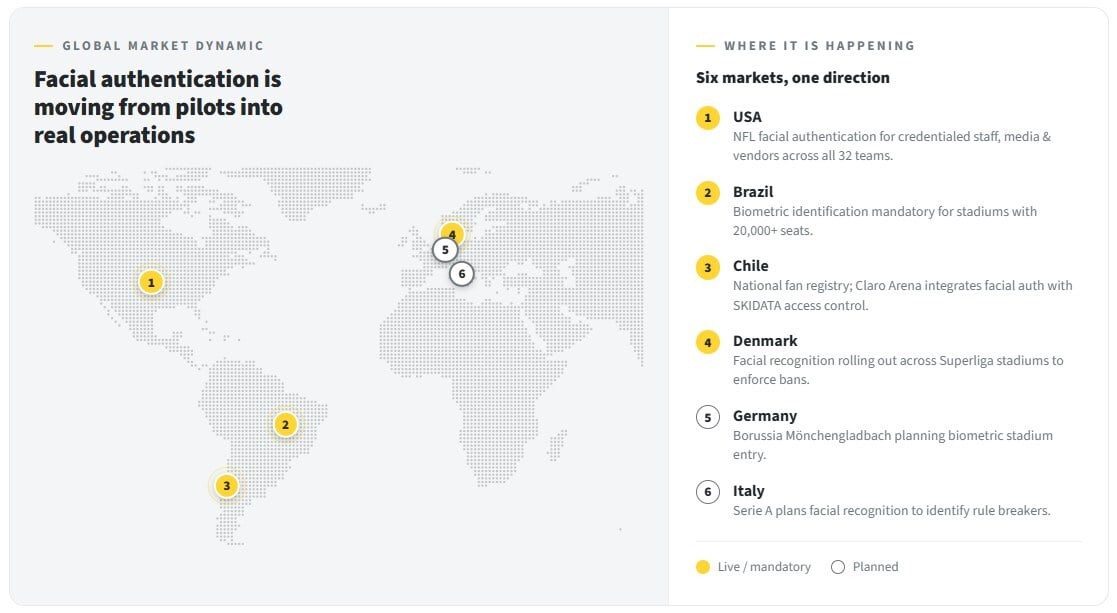
• Brazil has made biometric identification mandatory for spectator access in stadiums with more than 20,000 seats.
• Chile is moving fast with its national fan registry, and Claro Arena in Santiago is integrating facial authentication with SKIDATA access control for football matches.
• Denmark is rolling out facial recognition across Superliga stadiums to help enforce stadium bans.
• In the United States, the NFL uses facial authentication for credentialed staff, media, vendors and game-day personnel across all 32 teams.
• Italy has also announced plans to use facial recognition in Serie A stadiums to help identify rule breakers and improve security.
The pattern is clear.
Biometric access is moving from pilot projects into real stadium operations. Not because it sounds futuristic, but because it answers real operational challenges: long queues, ticket misuse, identity checks, banned spectators and pressure on security staff.
• For fans, the best version of this technology feels almost invisible. No searching for a ticket. No handover. No scanning delay. Just arrive, authenticate and enter.
• For operators, the value is just as clear: faster throughput, better control and a safer venue environment.
That is the context in which SKIDATA supports research into people and object surface authentication. The topic is not theoretical anymore. The market is already moving. The next step is to make these systems even faster, more reliable and easier to integrate into real venue operations.
That is where research comes in.
Where science meets access
Research becomes stronger when it meets real venue experience.
The Christian Doppler Laboratory explores new methods for authentication. SKIDATA brings practical experience from access environments where technology has to work under pressure, at scale and in real time.
Scientific research
What the lab explores
- Artificial intelligence
- Computer vision
- Multi-sensory recognition
- Object surface authentication
- Testing and validation
SKIDATA field experience
Where access has to work
- Stadiums and arenas
- Attractions and mountain destinations
- Parking and public spaces
- Ticketing and access hardware
- Peak-time operations
Together, science and field experience help answer one practical question:
how can access technology work better in real venues?
Real venues are not laboratory environments
A stadium entrance is not a perfect test setting.
People arrive in waves. Lighting conditions change. Fans wear caps, scarves and jackets. Some arrive in groups. Some need special access. Some arrive late. Others may try to enter with invalid, duplicated or misused tickets.
Access technology has to work in exactly these conditions.
That is why applied research matters. The Christian Doppler Laboratory investigates how person and object recognition can become more accurate and efficient in practical use cases, from event visitor authentication to counterfeit product detection.
For SKIDATA, the value lies in the exchange between science and real-world access experience. Researchers explore new methods. SKIDATA brings decades of practical knowledge from stadiums, arenas, attractions, mountain destinations, parking facilities and public spaces.
Together, this helps answer the questions that matter in daily venue operations: how access can remain fast, reliable and secure when thousands of people arrive at the same time.
Looking ahead
The future of access will not depend on one technology alone.
It will be shaped by the right combination of mobile tickets, connected gates, biometric options, real-time data, secure operations and practical venue knowledge.
That is why SKIDATA supports research into people and object surface authentication. Not because technology is the story, but because access has to work where it matters most: in real venues, with real people, under real operational pressure.
Access is more than a checkpoint.
It is the first step into the experience.
Discover SKIDATA access solutions for stadiums and arenas
Subscribe to our blog