


Parking Payment, Built for Leaner Setups

Shopping Centres Need Movement Intelligence. Shopping centre performance is becoming harder to read.
For a long time, footfall gave retail asset managers a simple starting point. More visitors suggested more opportunity. Fewer visitors raised concern. The number was useful because it was visible, comparable and easy to discuss in meetings. But the modern shopping centre is no longer simple enough for footfall alone.
Two centres can record similar visitor numbers and perform very differently. One may attract short, low-value visits with pressure at payment and exit. Another may attract fewer visits but stronger dwell time, better tenant interaction, higher repeat behaviour and more effective validation programmes. One may look busy but create frustration at peak periods. Another may move people through the asset with enough clarity that visitors spend more time doing what they came to do.
The question for asset managers is changing. What used to be ‘How many people came?’ is now What kind of movement did the asset create?
That is a more useful question because retail performance depends on more than volume. It depends on how visitors arrive, how long they stay, which journeys they follow, how often they return, how they pay, which tenants create validated movement, where pressure forms and whether the experience gives people a reason to come back.
Public retail property reporting already reflects this thinking. Leading retail owners discuss tenant turnover, trading density, foot count, vehicle count, tenant mix and redevelopment activity together because none of these signals tells the full story alone. A shopping centre is an operating asset. Its performance is shaped by the relationship between people, place, tenants, infrastructure and behaviour.
That is why parking and access data should sit closer to the commercial conversation. Too often, parking is still treated as an operational function. It is reviewed when there is a complaint, a queue, a payment issue, a tariff debate or a capex decision. But the access layer sees something commercially valuable long before a monthly asset report is produced.
• It sees when visitors arrive.
• It sees how demand forms around weekends, paydays, school holidays, anchor tenants, events, promotions and weather patterns.
• It sees whether customers are short-stay, long-stay, repeat, validated, staff, tenant, contractor, VIP or occasional.
• It sees where payment friction happens.
• It sees which validation programmes are being used and which may be underperforming.
• It sees how peak pressure affects exits, queues, staffing and customer perception.
None of this should be treated as parking trivia. These are asset signals.
For a shopping centre asset manager, the real value is not a dashboard full of parking numbers. The value is interpretation.
• If vehicle counts rise but tenant turnover does not move as expected, the asset team should ask what type of visits are being created.
• If trading density improves while footfall is flat, the team should understand whether the centre is attracting more purposeful visits, stronger tenant mix, better dwell patterns or higher-value journeys.
• If validation usage is concentrated among only a few tenants, leasing and marketing teams may need to understand which retailers are actively converting parking into customer value.
• If exit pressure increases after specific trading periods, operations teams may need to adjust guidance, payment options, staffing or communication before the problem becomes a reputation issue.
• If repeat visitor behaviour is visible, loyalty and tenant engagement become easier to discuss with evidence.
The commercial consequence is important. Shopping centres that cannot connect movement to asset decisions are forced to rely on partial evidence. They may know the centre was busy, but not whether the movement was healthy. They may know customers complained, but not where the journey broke. They may know tenants are asking for support, but not which access patterns could help them. They may approve parking investment without enough clarity on how the investment supports the wider asset.
That gap has a real place across MEIA.
In South Africa, retail asset owners are managing pressure around trading performance, infrastructure resilience, tenant mix and customer expectation. In the Gulf, destination retail often sits inside larger mixed-use environments where shoppers, residents, hotel guests, office users, delivery vehicles and VIP journeys overlap. In India, scale and payment diversity create a different kind of complexity. In parts of Africa, reliability and phased modernisation can matter as much as digital sophistication.
The contexts differ, but the buyer problem is consistent. Shopping centers need better evidence about how people move through the asset.
This is where SKIDATA has permission to speak. Not as a company selling parking equipment. Not as a brand promising that technology will solve retail performance. That would be too narrow and too easy to dismiss.
SKIDATA's relevance is in helping shopping centers connect access, parking, payment, validation, guidance and reporting into a clearer operating picture. The point is not to overwhelm the asset team with more data. The point is to help them see what movement is telling them about the destination.
• For a center manager, that may mean reducing daily friction and managing peak periods with greater confidence.
• For an asset manager, it may mean understanding how access supports tenant performance and customer experience.
• For a REIT executive, it may mean comparing portfolio assets with more consistency and making better investment decisions.
• For leasing and marketing teams, it may mean seeing which tenants, campaigns or visitor groups are actually creating movement.
• For operations teams, it may mean fewer assumptions and faster response.
The practical takeaway is that Shopping centers should treat parking as part of the asset intelligence layer instead of data as a facilities report.
That does not mean every access signal becomes a commercial conclusion. It does mean the right questions become easier to ask.
• Which visitors are we attracting?
• Which journeys are growing?
• Where does friction reduce confidence?
• Which tenants are using validation effectively?
• Where do peaks create avoidable pressure?
• Which assets are operating consistently across the portfolio?
• Which investment decisions are supported by evidence rather than complaints?
Retail is being shaped by the ability to understand movement quality. How people arrive, how they behave, how they return, how they interact with tenants and how the destination performs around them.
For shopping centres, that is the next level of commercial intelligence. And it starts before the shopper reaches the store.
Further Reading
SKIDATA Shopping Mall Parking
SKIDATA Reporting and Analytics
SKIDATA Digital Parking Validation
SKIDATA Parking Guidance and Digital Signage
SKIDATA Parking and Mobility Solutions
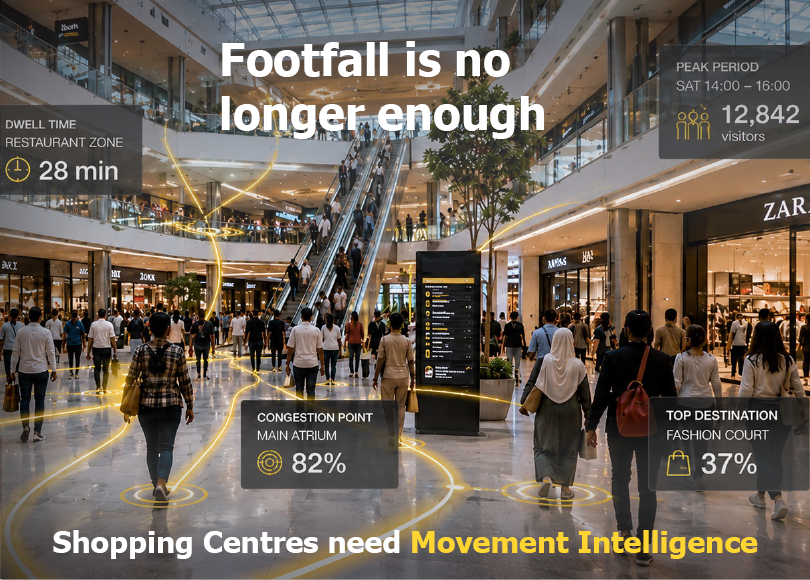
Movement Intelligence. AI-Enhanced Image
.